If you noticed sudden ranking drops or traffic fluctuations on your website between June 24 and June 26, 2026, you are not imagining things. Google just finished rolling out the Google June 2026 spam update, a global algorithm change that affected websites across all languages and regions simultaneously. The SEO community has been buzzing with reports of significant ranking volatility, and many website owners are trying to understand what happened, whether their site was affected, and what to do next.
In this article we break down everything you need to know about the Google June 2026 spam update, including what it is, what it targets, which websites are most at risk, and the exact steps to take if your rankings dropped.
If you want professional help auditing your website after this update, our SEO services at BitsRanker are built specifically for situations like this.
What is the Google June 2026 Spam Update?
The Google June 2026 spam update is a global search ranking update designed to improve Google’s automated ability to detect and demote websites that violate its spam policies. The update began rolling out on June 24, 2026 at 9:00 AM Pacific Time and completed on June 26, 2026, a total rollout duration of just over 48 hours.
This makes it the second confirmed spam update of 2026, following the March 2026 spam update which completed in under 24 hours making it the fastest spam rollout on record at that time.
Google officially described it as a normal spam update that applies globally and across all languages. Unlike a core update which broadly re-evaluates content quality across the entire web, the Google June 2026 spam update specifically targets websites that are violating Google’s existing spam policies through manipulative SEO techniques.
The update runs through SpamBrain, Google’s AI-powered spam detection system that has underpinned every spam update since 2022. SpamBrain continuously learns to detect new patterns of manipulative behavior, and each spam update represents a notable improvement to how the system identifies and acts on spam violations.
Google June 2026 Spam Update: 7 Critical Facts
Fact 1: It Rolled Out Globally in Just 48 Hours
The Google June 2026 spam update started on June 24 and completed on June 26, 2026, affecting all languages and all regions simultaneously. With a rollout of just over 48 hours, it was faster than most spam updates but significantly more impactful than its speed suggested. Third-party ranking trackers reported major spikes in search result volatility during the rollout window, and many webmasters reported sudden and severe drops in organic traffic.
Fact 2: It is a Spam Update, Not a Core Update
This is one of the most important distinctions to understand. Many website owners confuse spam updates and core updates but they work very differently and require very different responses.
A core update is a broad recalibration of how Google evaluates content quality and relevance across the entire web. A spam update is narrower and more targeted. It specifically improves Google’s ability to detect and penalize websites that are violating its spam policies through manipulative tactics.
The Google June 2026 spam update is a spam update, which means it did not broadly re-rank content for quality reasons. It targeted specific policy violations. If your rankings dropped, the question to ask is not whether your content is good enough but rather whether any part of your site crosses the line into spam policy territory.
Fact 3: It Does NOT Target Link Spam or Site Reputation Abuse
One important detail confirmed about the Google June 2026 spam update is what it does not target. The update does not target link spam and does not target the site reputation abuse policy. This rules out the most common misread which is assuming any spam update is a link penalty.
This also means that if your rankings dropped during this update, the cause is almost certainly content-level spam rather than link-related issues. That is actually useful information for recovery because content-level spam violations can be fixed and reversed over time, unlike link spam penalties where the ranking benefit from removed spammy links cannot be regained.
Fact 4: It Follows Google’s New AI Spam Policy
An important piece of context for the Google June 2026 spam update is that on May 15, 2026, just 40 days before this rollout, Google updated its spam policies to explicitly cover attempts to manipulate generative AI responses including AI Overviews and AI Mode in search results.
This means that tactics designed to game AI-generated answers in Google Search now sit in the same enforcement category as classic spam techniques like cloaking and keyword stuffing. While Google has not explicitly confirmed that the June 2026 update was specifically enforcing these new AI spam rules, the timing is significant. SpamBrain now has explicit policy backing to act on AI answer manipulation and this rollout landed just six weeks after that policy change.
Fact 5: These are the Websites Most at Risk
The Google June 2026 spam update is most likely to affect websites using the following tactics:
Scaled AI Content Without Editorial Review: Google does not penalize content for being AI-generated. It penalizes content that is unhelpful, scraped, or mass-produced to manipulate rankings without delivering genuine value. Websites publishing large volumes of AI-generated articles without fact-checking, original insights, or human editorial review are highly vulnerable.
Thin Content and Low-Value Pages: Websites with hundreds or thousands of pages offering minimal original value are more likely to be affected. Pages created solely to target keywords without satisfying user intent are increasingly vulnerable to SpamBrain detection.
Keyword Stuffing: Repeating keywords unnaturally throughout content no longer improves rankings and is actively penalized. Natural, helpful language always outperforms artificially keyword-dense writing.
Spammy Redirects and Cloaking: Showing different content to Google than to real users is a direct spam policy violation and one of the clearest targets for SpamBrain.
Automatically Generated Doorway Pages: Mass-produced location pages, comparison pages, and other templated pages with little original content are among the site types most reported to have been impacted during the rollout.
Hacked or Scraped Content: Any content on your site that was copied from other sources or injected through a security breach represents a spam policy violation that this update is designed to catch.
Fact 6: Your Rankings May Have Dropped Even if You Did Nothing Wrong
One important and often frustrating aspect of spam updates is that some websites experience ranking fluctuations during the rollout period even without any actual spam violations. Normal volatility during a global rollout can cause temporary ranking movements that stabilize once the update completes.
If your rankings dropped between June 24 and June 26, the first step is to wait until the rollout is confirmed complete, which it now is, and then evaluate whether the drop is sustained or temporary. Temporary fluctuations during rollout are common. A sustained drop after June 26 is a stronger signal that your site may have been genuinely affected.
Also worth noting: if you were already dealing with the aftermath of the May 2026 core update, separating the effects of both updates requires careful analysis of your Google Search Console data with the correct dates annotated.
Fact 7: Recovery Takes Months, Not Days
This is the most important fact for anyone whose rankings dropped during the Google June 2026 spam update. Recovery is possible but it is slow. Google has stated clearly that improvements may take several months for its automated systems to reassess that a site is now complying with spam policies.
SpamBrain does not typically impose a hard penalty. It neutralizes the ranking signals that underpinned a manipulative advantage. Once those signals are removed, the undeserved boost disappears and it does not automatically come back just because you make changes. You need to make genuine improvements and then wait for Google’s systems to relearn that your site is clean and compliant.
What is SpamBrain and How Does It Work?
SpamBrain is Google’s AI-based spam prevention and detection system. It has underpinned every spam update since 2022 and continuously evolves to detect new patterns of manipulative behavior that violate Google’s spam policies.
Unlike manual penalties applied by human reviewers, SpamBrain operates automatically at massive scale across all of Google Search. When a spam update rolls out, it represents a notable improvement to how SpamBrain identifies and acts on spam violations, not necessarily a change to the underlying rules themselves.
The June 2026 spam update did not introduce new spam policies. It improved SpamBrain’s enforcement of policies that already existed. This is an important distinction because it means the framework for evaluating impact and planning recovery is exactly the same as before the update.
How to Check if the Google June 2026 Spam Update Affected Your Website
If you are concerned your website may have been impacted, here is exactly how to check:
Step 1: Annotate June 24 in Google Search Console
Add an annotation for June 24, 2026 in your reporting so you can clearly separate the update’s effects from anything that came before or after. Clean date tracking is essential for accurate analysis.
Step 2: Compare Traffic and Rankings
Open your analytics and compare organic traffic from after June 26 against your baseline before June 24. Look for sustained drops in organic clicks, impressions, and keyword rankings rather than temporary fluctuations during the rollout window.
Step 3: Identify Affected Page Types
Segment your data by page type including blog posts, service pages, product pages, and landing pages. If only specific categories of pages dropped, that pattern gives you a clearer signal of what SpamBrain may have flagged.
Step 4: Review Against Google’s Spam Policies
If you identify a sustained drop, review your website honestly against Google’s spam policies. Look for thin content, keyword stuffing, misleading page titles, spammy redirects, scraped content, or any other practices that could appear manipulative.
Step 5: Monitor in Google Search Console
Use Google Search Console{rel=”nofollow”} to monitor your performance data closely. The Coverage report, the Performance report, and the Manual Actions section are the most relevant places to check for signals of impact.
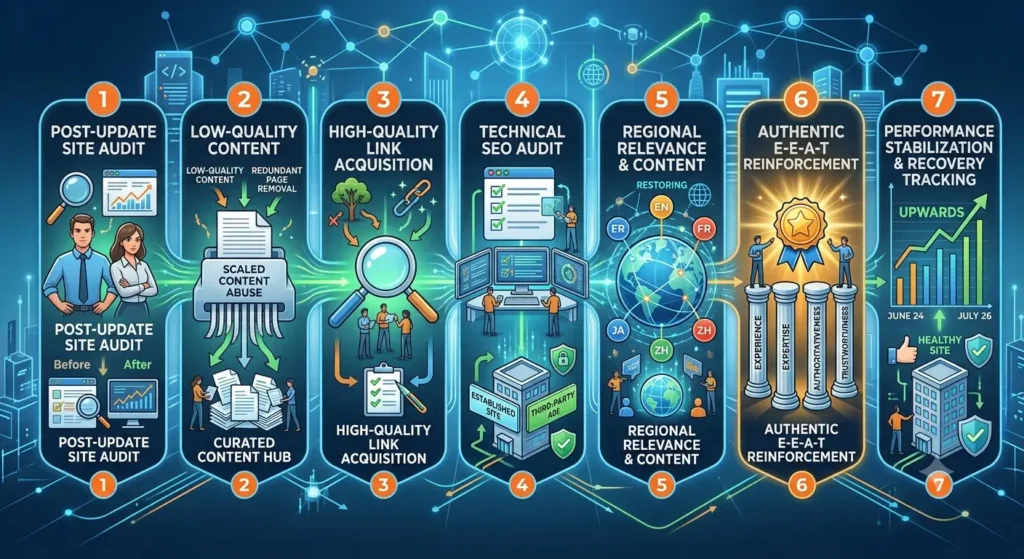
How to Recover from the Google June 2026 Spam Update
If your website was genuinely affected, here is the recovery roadmap:
Do Not Make Panic Changes
The rollout is now complete as of June 26, 2026. Making sweeping changes to your site without proper diagnosis makes it harder to identify what actually caused the drop. Wait for completion, then audit carefully.
Audit Your Content Honestly
Review every page on your website through the lens of Google’s spam policies. Ask honestly: Is this page providing genuine value to a real user? Or was it created primarily to rank for a keyword? Remove or substantially rewrite any pages that fall into the second category.
Remove or Rewrite Thin and Low-Value Pages
Pages with very little original content, pages that simply repeat information available elsewhere without adding new insight, and pages created to target keywords without satisfying user intent are the clearest targets for cleanup.
Fix Technical Issues
Check for any suspicious redirects, cloaking issues, or hacked content that may have been injected without your knowledge. A clean technical foundation is essential for long-term search visibility.
Focus on E-E-A-T Signals
Google’s quality framework of Experience, Expertise, Authoritativeness, and Trustworthiness has never mattered more than it does in 2026. Add author bios, credentials, transparent contact information, and genuine expertise signals to every page of your website. Sites with strong E-E-A-T signals consistently perform better across both spam updates and core updates.
Be Patient
Recovery takes months. Google has been explicit about this. Once you make genuine improvements, you need to wait for SpamBrain’s systems to reassess your site over time. There are no shortcuts and no quick fixes. Consistent, honest improvement is the only path forward.
How to Protect Your Website from Future Spam Updates
The best defense against any spam update is building a website that Google would be proud to rank. Here is what that looks like in practice:
Publish Original Content: Every page on your website should offer something genuinely useful that a real person would want to read. Write for your audience first and for search engines second.
Maintain Technical Cleanliness: A technically sound website with no crawl errors, fast loading speeds, proper redirects, and clean architecture gives SpamBrain nothing to flag. Our SEO services include full technical audits that identify and fix every issue before it becomes a ranking problem.
Build Genuine Authority: Earn backlinks naturally through high-quality content, real relationships, and genuine value. Avoid any link schemes, paid links, or private blog networks that violate Google’s guidelines.
Be Transparent: Clearly identify who you are, what your business does, and why visitors should trust you. Transparency is a strong E-E-A-T signal that Google rewards consistently.
Monitor Consistently: Check your Google Search Console data regularly and annotate every major Google update in your reporting so you can quickly identify cause and effect when rankings change.
What This Means for Your SEO Strategy in 2026
The Google June 2026 spam update is part of a broader pattern of increasingly frequent and sophisticated enforcement from Google in 2026. Google rolled out four confirmed ranking incidents between February and June 2026, a faster pace than any previous year.
This acceleration reflects a company tightening enforcement across multiple fronts simultaneously including AI-generated content quality, AI answer manipulation, link spam, and scaled content abuse. The message is clear: sustainable SEO in 2026 requires genuine expertise, original content, and a commitment to serving real users rather than gaming algorithms.
Businesses that invest in proper SEO strategy, the kind built on technical foundations, original content, and honest link building, consistently turn every Google update into a non-event. Every update rewards exactly what good SEO has always been about: creating a website that people genuinely find helpful.
If you are concerned about your website’s compliance after the Google June 2026 spam update or want to ensure your SEO strategy is built to withstand whatever Google rolls out next, our digital marketing team at BitsRanker provides comprehensive SEO audits and ongoing strategy that keeps your website on the right side of every Google update.
Final Thoughts on the Google June 2026 Spam Update
The Google June 2026 spam update is a reminder that Google’s enforcement systems are becoming faster, smarter, and more sophisticated with every passing month. The update completed in just 48 hours but caused significant ranking volatility across multiple industries and regions.
The businesses most affected are those that took shortcuts including thin content, keyword stuffing, scaled AI pages without editorial value, and manipulative tactics. The businesses that were not affected are those that built their online presence the right way from the beginning.
If your rankings dropped, the path forward is clear: audit honestly, fix genuinely, be patient, and build for the long term. If your rankings held steady or improved, keep doing exactly what you are doing and use this update as motivation to raise the bar even higher.
For professional guidance on auditing your website after the Google June 2026 spam update and building an SEO strategy that performs regardless of algorithm changes, explore our SEO services at BitsRanker.