Google Ads vs Facebook Ads: Which is Better in 2026?
If you have a marketing budget and you are trying to decide between Google Ads vs Facebook Ads, you are asking one of the most important questions in digital marketing right now. Both platforms are powerful. Both can generate leads and sales. But they work in completely different ways, and choosing the wrong one for your business can mean months of wasted budget before you realize the fit was off.
In this article we compare Google Ads vs Facebook Ads across every metric that actually matters including cost, targeting, conversion rates, ROI, and best use cases, so you can make the right call for your business in 2026 and stop second-guessing your ad spend.
If you are looking for professional management of both platforms, explore our Google and Meta Ads management services at BitsRanker.
The Core Difference Between Google Ads vs Facebook Ads
Before comparing costs and conversion rates, you need to understand the fundamental difference between these two platforms because everything else flows from this one point.
Google Ads vs Facebook Ads comes down to one simple distinction: intent versus discovery.
Google Ads shows your ad to people who are actively searching for what you sell. The user has already identified a need and is looking for a solution. You are capturing demand that already exists.
Facebook Ads shows your ad to people based on their interests, demographics, and behaviors. They are not searching for anything. You are interrupting their scroll with something relevant enough to make them stop and pay attention. You are creating demand.
Google processes more than 5.6 billion searches every single day. Each search query represents a moment when someone is actively looking for information, a product, or a service. Facebook has over 3 billion active users worldwide spending significant time scrolling feeds, watching videos, and engaging with content. Both represent enormous opportunities, but they require completely different strategies to get right.
Google Ads vs Facebook Ads: Head to Head Comparison
| Feature | Google Ads | Facebook Ads |
|---|---|---|
| Primary Mechanism | Intent based Search | Interest based Social |
| Average CPC | $2.69 | $0.62 |
| Average Conversion Rate | 4.40% | 1.85% |
| Best For | High intent buyers | Brand awareness and discovery |
| Ad Format | Text, Shopping, Display | Image, Video, Carousel |
| Targeting | Keywords, Demographics | Interests, Behaviors, Lookalikes |
| Speed to Results | Fast (hours) | Slower (days to weeks) |
| Learning Curve | Steep | Moderate |
| Minimum Budget | $300 per month | $200 per month |
Cost Comparison: Google Ads vs Facebook Ads
Cost is usually the first thing businesses look at when comparing Google Ads vs Facebook Ads and the numbers tell an interesting story.
Facebook Ads average CPC is $0.62 versus Google Ads at $2.69, making Facebook significantly cheaper per click on the surface. But here is the critical point most businesses miss completely.
Google Ads higher CPC is offset by higher conversion rates. Users clicking a Google search ad are further down the buying funnel because they searched for your product with purchase intent. Facebook lower CPC reaches more people, but a smaller percentage convert on the first visit because those people were not actively looking to buy.
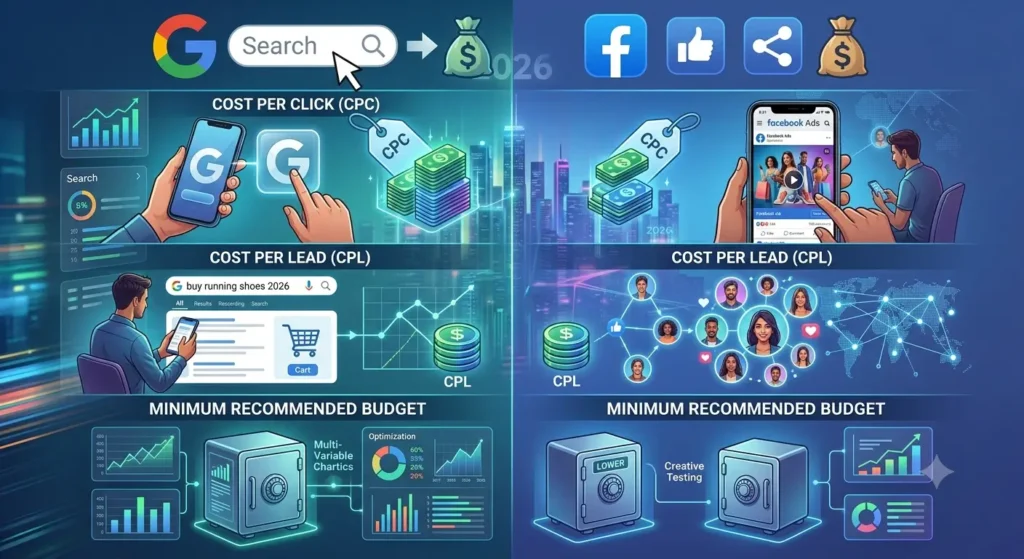
The average conversion rate for Google Search Ads across industries is 4.40% versus 1.85% for Facebook Ads. The average cost per acquisition is $48.96 for Google Ads and $19.68 for Facebook Ads in eCommerce.
A business owner looks at those numbers and says Facebook is cheaper. A smart advertiser asks whether the cheaper acquisition actually created a better customer. Lower CPC and lower CPA are only advantages if those customers convert, retain, and generate real revenue for your business.
Cost by Industry
eCommerce: Facebook delivers lower CPC making it ideal for product discovery. Google works well for remarketing and capturing high intent product searches.
Real Estate: Facebook visual ad formats and geo targeting make it cost effective for listing promotion, while Google captures high intent searches from active home buyers.
SaaS and Technology: Google higher CPC is justified by stronger purchase intent from users actively searching for software solutions. Facebook works better for top of funnel awareness campaigns.
Healthcare: Both platforms offer competitive costs, but Google search ads are generally more straightforward for healthcare providers due to compliance considerations.
Targeting: How Each Platform Finds Your Customers
Understanding how each platform targets audiences is essential to the Google Ads vs Facebook Ads decision for your business.
Google Ads Targeting
Google Ads targeting is built around search intent. You choose keywords that match what people search for. A user searching “emergency plumber near me” or “best accountant in London” has extremely high purchase intent. You do not need to convince them they have a problem. They already know they have a problem and they are looking for someone to solve it.
Google also offers demographic overlays, in market audiences, and remarketing lists that allow you to layer additional targeting on top of keyword intent, giving experienced advertisers strong control over who sees their ads and when.
Facebook Ads Targeting
Facebook Ads targeting is built around audience modeling. You can target people based on age, location, interests, job title, income level, purchase behavior, and lookalike audiences built from your existing customers.
This makes Facebook exceptionally powerful for reaching new audiences who do not yet know they need your product. If your business sells something people do not actively search for but would buy if they saw it, Facebook is where you need to be. The platform finds people who match the profile of your ideal customer and serves your ad directly into their feed.
Which Platform Gets Results Faster?
Speed is a major factor in the Google Ads vs Facebook Ads comparison, especially for businesses that need leads quickly.
Google Ads wins for speed. A user searching for your product or service can see your ad, click, and purchase within minutes. Google Search captures bottom of funnel intent. These users have already decided they need what you offer and are comparing their options right now.
Facebook Ads operates on a longer timeline. A user scrolling their Instagram feed sees your ad, clicks through, browses your site, and leaves without buying. They come back via a retargeting ad three days later, add to cart, and complete the purchase two days after that. The total conversion cycle is typically 5 to 14 days for most products and services.
This does not make Facebook worse. It means the two platforms serve different parts of the buyer journey. Google closes sales quickly. Facebook builds awareness and warms audiences over time. Understanding this distinction changes how you should think about budget allocation entirely.
Google Ads vs Facebook Ads: Best Use Cases by Business Type
When to Choose Google Ads
Local Service Businesses: Plumbers, lawyers, dentists, accountants, electricians. Anyone whose customers search for them when they have an urgent need. Google Ads captures that moment of high intent perfectly and consistently delivers strong ROI for local service businesses.
High Intent eCommerce: Products people search for by name or category. Someone searching for a specific product on Google is far closer to buying than someone who sees a Facebook ad for the same product while scrolling their feed.
B2B Lead Generation: Decision makers searching for specific software, tools, or professional services. Google captures that commercial search intent at exactly the right moment in the buying process.
Short Sales Cycle Businesses: If your customers typically make a decision within a few days of discovering you, Google Ads is the better fit. The platform is built for capturing people who are ready to act now.
When to Choose Facebook Ads
Product Discovery and eCommerce: Facebook excels at introducing products to people who did not know they wanted them. Visually appealing, lifestyle oriented, and impulse buy products perform exceptionally well on Facebook and Instagram.
Brand Awareness Campaigns: If people do not know your business exists yet, Facebook reaches them before they ever search on Google. Building brand recognition at scale with a targeted audience is one of Facebook greatest strengths.
Event Promotion: Webinars, product launches, local events, and limited time offers all perform strongly on Facebook where visual storytelling drives registrations and attendance at a lower cost than search advertising.
Retargeting: Re-engaging website visitors who did not convert is one of Facebook most powerful capabilities. Showing your ad to someone who already visited your website converts at significantly higher rates than cold audience campaigns.
Long Sales Cycle Businesses: For B2B companies and high ticket service businesses with 30 to 90 day decision timelines, Facebook nurturing sequences keep your brand in front of prospects throughout the entire consideration period.
The Learning Curve: Which Platform is Easier to Manage?
Google Ads has a steeper learning curve. Keyword research, match types, Quality Score optimization, negative keyword management, bid adjustments, and ad extensions all require significant time to learn. Most businesses need 2 to 3 months to become competent and 6 or more months to optimize campaigns effectively.
Facebook Ads is easier to start but harder to scale. The interface is more intuitive and launching a basic campaign takes minutes. But performance depends heavily on creative quality and audience strategy, skills that take real time and experience to develop properly. Scaling from $1,000 per month to $10,000 per month on Facebook requires sophisticated understanding of audience segmentation, creative rotation, and budget allocation.
For businesses without dedicated in house marketing expertise, working with a professional digital marketing agency that manages both platforms is almost always more cost effective than the trial and error of learning both independently.
AI and Automation in Google Ads vs Facebook Ads in 2026
One of the biggest shifts in the Google Ads vs Facebook Ads landscape in 2026 is the role of artificial intelligence and automation on both platforms.
Google Performance Max automatically distributes your ad assets across the entire Google ecosystem including Search, Display, YouTube, Gmail, and Maps, but offers limited transparency into which specific placements are driving your results.
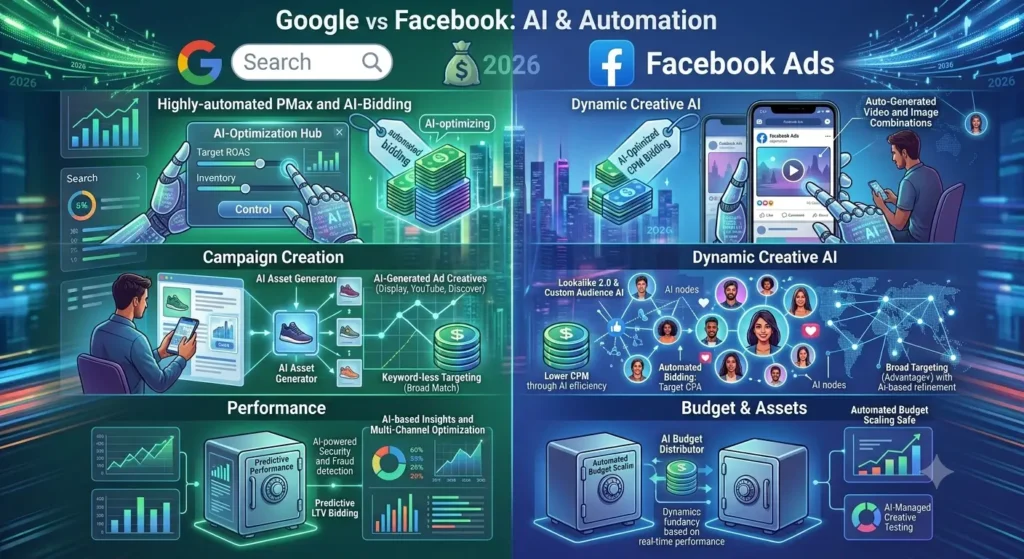
Facebook Advantage+ manages targeting, placements, and budgets automatically but requires a minimum of 50 conversions per week for the algorithm to stabilize and optimize properly.
Both platforms now generate AI powered ad copy and creative suggestions. The advertisers who benefit most from these tools in 2026 are those who know how to guide the automation with strong brand guidelines, clear conversion goals, and well structured campaign setups rather than letting the platforms run without direction.
The fundamentals of strong targeting, compelling creative, and clear conversion objectives matter more in 2026 than ever before. Automation amplifies good strategy and it also amplifies poor strategy equally.
How Much Budget Do You Need for Google Ads vs Facebook Ads?
For Google Ads vs Facebook Ads to deliver meaningful results, here are the minimum recommended monthly ad spend budgets:
| Platform | Minimum Budget | Recommended Budget |
|---|---|---|
| Google Ads | $300 per month | $500 to $1,000 per month |
| Facebook Ads | $200 per month | $300 to $800 per month |
| Both Combined | $500 per month | $800 to $1,500 per month |
These are ad spend budgets separate from management fees. The more competitive your industry, the higher the recommended budget. Our Google and Meta Ads plans at BitsRanker start from $300 per month management fee with flexible ad spend across both platforms.
Google and Facebook both offer free tools to help you get started with paid advertising. You can create your first Google Ads campaign directly through the official platform at Google Ads{rel=”nofollow”} and manage your Facebook and Instagram campaigns through Meta Business Manager{rel=”nofollow”}. Both platforms offer detailed tutorials and guides to help beginners understand the basics before spending their first dollar on advertising.
The Smartest Strategy: Use Both Platforms Together
The businesses generating the strongest ROI from paid advertising in 2026 are not choosing between Google Ads vs Facebook Ads. They are using both as a coordinated system that covers the full customer journey.
Facebook builds awareness with new audiences. Google captures the search demand that Facebook awareness generates. Facebook retargeting re-engages visitors who clicked from Google but did not convert. Google remarketing closes the loop with warm audiences across both platforms.
Here is a practical starting framework for combining both platforms:
Step 1: Use Facebook Ads for top of funnel awareness. Reach new audiences, generate interest, and build brand recognition with targeted social campaigns.
Step 2: Use Google Ads to capture the search demand that your Facebook awareness generates. People who saw your Facebook ad and then searched for you on Google are highly likely to convert.
Step 3: Use Facebook retargeting to re-engage visitors who came from Google but did not buy. Show them a follow up ad with a stronger offer or social proof to bring them back.
Step 4: Review your cost per acquisition on both platforms after 60 days and reallocate budget toward whichever platform is delivering the better results for your specific business.
A practical starting split is 70% of your budget on the platform that fits your business best and 30% on the other. Let 60 days of real data guide every budget decision after that.
Final Verdict: Google Ads vs Facebook Ads in 2026
The Google Ads vs Facebook Ads debate does not have a single winner. It has a right answer for each business situation.
Google Ads wins when your customers are actively searching and ready to buy. It delivers faster results, higher intent traffic, and stronger conversion rates for businesses with a clear search demand for their products or services.
Facebook Ads wins when you need to reach new audiences, build brand awareness, and nurture prospects over time. It delivers lower cost per click, broader reach, and powerful audience targeting capabilities that Google simply cannot match.
The businesses generating the strongest returns from paid advertising in 2026 use both platforms as a coordinated system. Google captures demand. Facebook creates it. Together they cover the full customer journey from first awareness to final purchase.
If you want expert management of your Google Ads and Facebook Ads campaigns without the trial and error learning curve, our Google and Meta Ads management team at BitsRanker handles everything from strategy and setup to daily optimization and monthly reporting so every dollar of your ad budget works as hard as possible.
If you are still building your organic presence alongside paid ads, explore our SEO services to ensure your business grows on both paid and organic channels at the same time.